Building the Architecture: How Future Signals 2026 Emerged
We just released Future Signals 2026. Not talking about the five signals today.
I want to show you how we built the research system itself.
Most trend reports follow a template. Gather data, spot patterns, write conclusions. We didn't start with a methodology. We started with a problem: how do you identify strategic signals before they become obvious?
The architecture emerged while building it.
Cross-Dimensional Convergence
Started simple: read research, spot patterns. Didn't work. Too much noise. Patterns showing up in VC funding but nowhere else. That's hype, not signal.
Built a scoring system. Six research dimensions:
- Patents (what's being protected)
- Academic pipeline (what's leaving labs)
- VC/Investment (where capital flows)
- Regulatory formation (what constraints emerge)
- Cross-Domain convergence (new categories forming)
- Frontier voices (expert bets)
Each pattern gets scored out of 12. If it only shows in one dimension → ignore it. If it shows across all six → real.
We found 9 patterns. Scored them. Top pattern hit 10/12. Weakest hit 3/12.
The Clustering Decision
9 patterns isn't 9 signals.
Some were subsets. Some were consequences. "Scaling laws plateau" isn't a standalone signal - it's WHY execution commoditizes and intent becomes scarce. That's Signal 5.
"World models" and "efficiency pivot" aren't separate from "physical AI" - they're what enables it. That's Signal 4.
"Regulatory cliff" isn't separate from "fragmentation" - it's one manifestation. That's Signal 2.
9 patterns → 5 signals through dependency analysis.
Friction Analysis
Patterns look real. Could still fail.
Built friction mapping. Five types for each signal: technical, organizational, economic, regulatory, social. With specifics.
Signal 1 (Agents):
- Integration remains #1 killer: 46% of enterprises cite this
- Reliability isn't there yet: 82% accuracy on document processing
- Multi-agent coordination fails at scale: 40% failure rate
- Cost overruns are standard: 85% misestimate by >10%
- ROI remains hard to prove: only 23% can quantify productivity gains
Not opinions. Numbers.
Then the kill condition: "What would have to be true for this signal to NOT materialize?"
For Agents: "Integration complexity proves insurmountable, and/or high-profile failures cause retreat to safer 'copilot' models."
Action Translation
Here's where it changed.
We had trajectory models. Optimistic path, baseline path, constrained path based on friction resolution. Started writing them up as scenarios.
Hit a problem: Readers don't know what to do with three possible futures.
Rebuilt it. Converted trajectories into hedged action timelines.
Readers never see "here are three scenarios." They see:
- Watch indicators (acceleration signs, friction signs)
- NOW actions (30 days, works in any trajectory)
- SOON actions (100 days, infrastructure decisions)
- LATER actions (12 months, strategic positioning)
- The trap (common mistakes: over-reaction, under-reaction, wrong-focus)
Optimistic trajectory informs SOON actions. Baseline informs NOW actions. Constrained informs what to watch for stalling.
We did the scenario planning internally. Gave them executable guidance.
The Inversion
Final layer: flip each signal to find the non-obvious insight.
Obvious: Agents automate work
Inversion: Agents are infrastructure that enables new org designs
Obvious: Fragmentation closes markets
Inversion: Sovereignty creates moats
Obvious: Bio-AI accelerates discovery
Inversion: We're shifting from archaeology to architecture
The inversion is what separates signal from trend spotting.
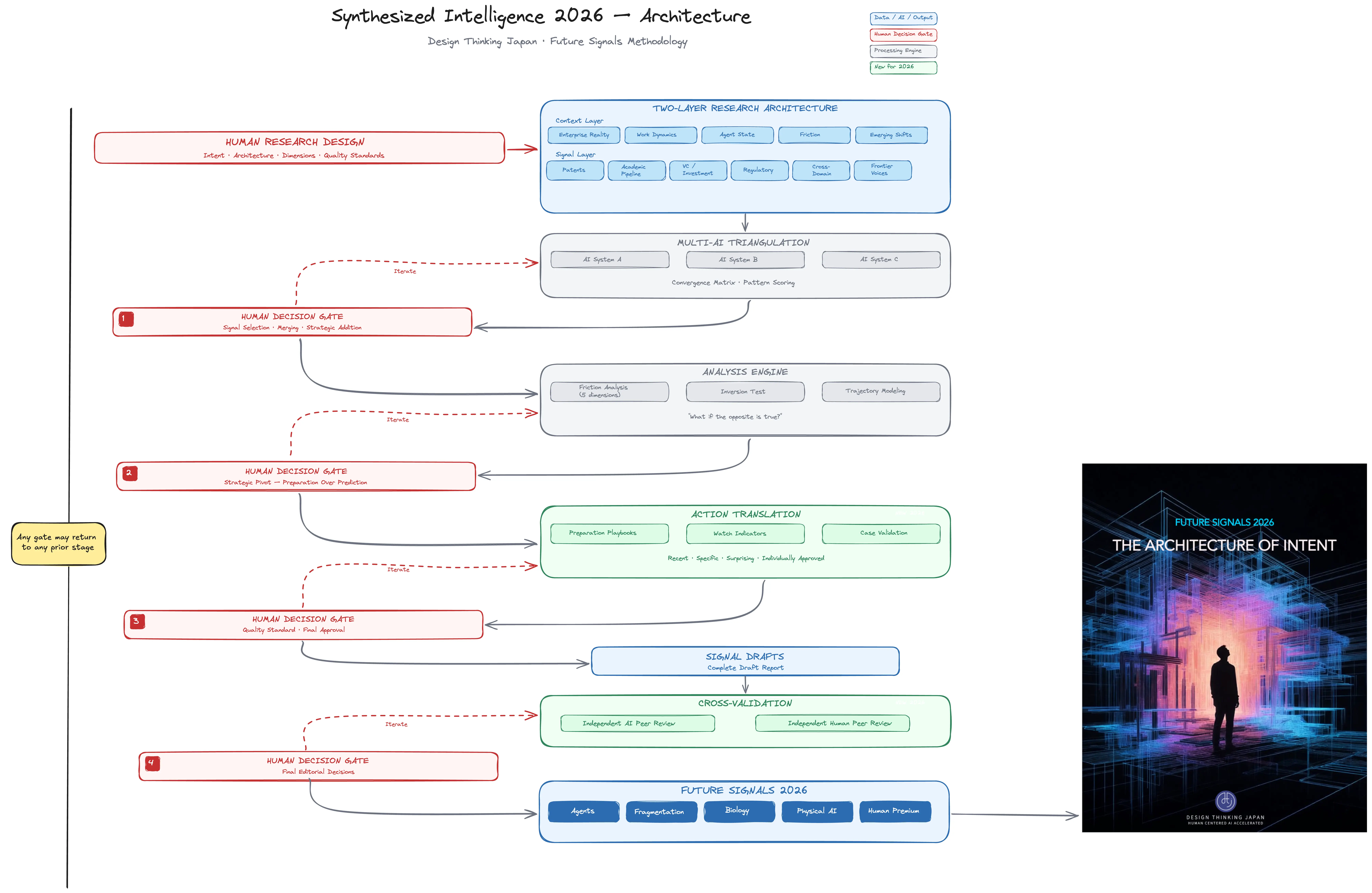
The methodology diagram we published? That's documentation of what we discovered, not a pre-planned system.
Each component emerged when we hit a problem:
- How do we know what's real? → Convergence matrix
- How do we know what could fail? → Friction analysis
- How do we make it actionable? → Action translation
- How do we find non-obvious insight? → Inversion test
This is Software 3.0 applied to research itself. We didn't spec out a rigid process. We iterated toward emergent behavior.
The gates aren't templated checkpoints. They're formalized versions of judgment calls made in the moment. Human intent at each decision point. AI capability to execute at scale.
When execution is automated and abundant, the only thing left to "design" is intent.
We call it the Architecture of Intent.
We practiced what we're describing.
The full report: designthinkingjapan.com/thinking
The methodology: github.com/DesignThinkingJapan/future-signals-2026-report
Adalberto Gonzalez Ayala
Design Thinking Japan