Why We Went Racing
A note on why DTJ took its real-time AI work to the racetrack.
Racing doesn't forgive.
A cornering decision at 280 km/h. A tire degrading in real time. A gap that opens or closes inside a second.
The track is one of the few places left where slow is the same as wrong.
So we went there.
Not as fans. As builders.
racing.designthinkingjapan.com is where we put our work under conditions that don't negotiate. Live telemetry. Voice AI as a co-engineer. Computer vision that watches the line a driver takes and tells you what it sees, in the moment.
We didn't go for the romance of motorsport. We went because AI behaves differently when the deadline is now and the data never stops arriving. The margin that lets a clean demo look impressive disappears at speed.
A car at race pace is reality with the volume turned up.
Some of what we've found:
LLMs that solve a strategy question with elegance, then fail at counting bytes in a packet they've parsed a thousand times. We named that pattern. We designed around it.
Adaptive vision that calibrates on the fly. Point at a competitor. Track the line. No labeling. No retraining.
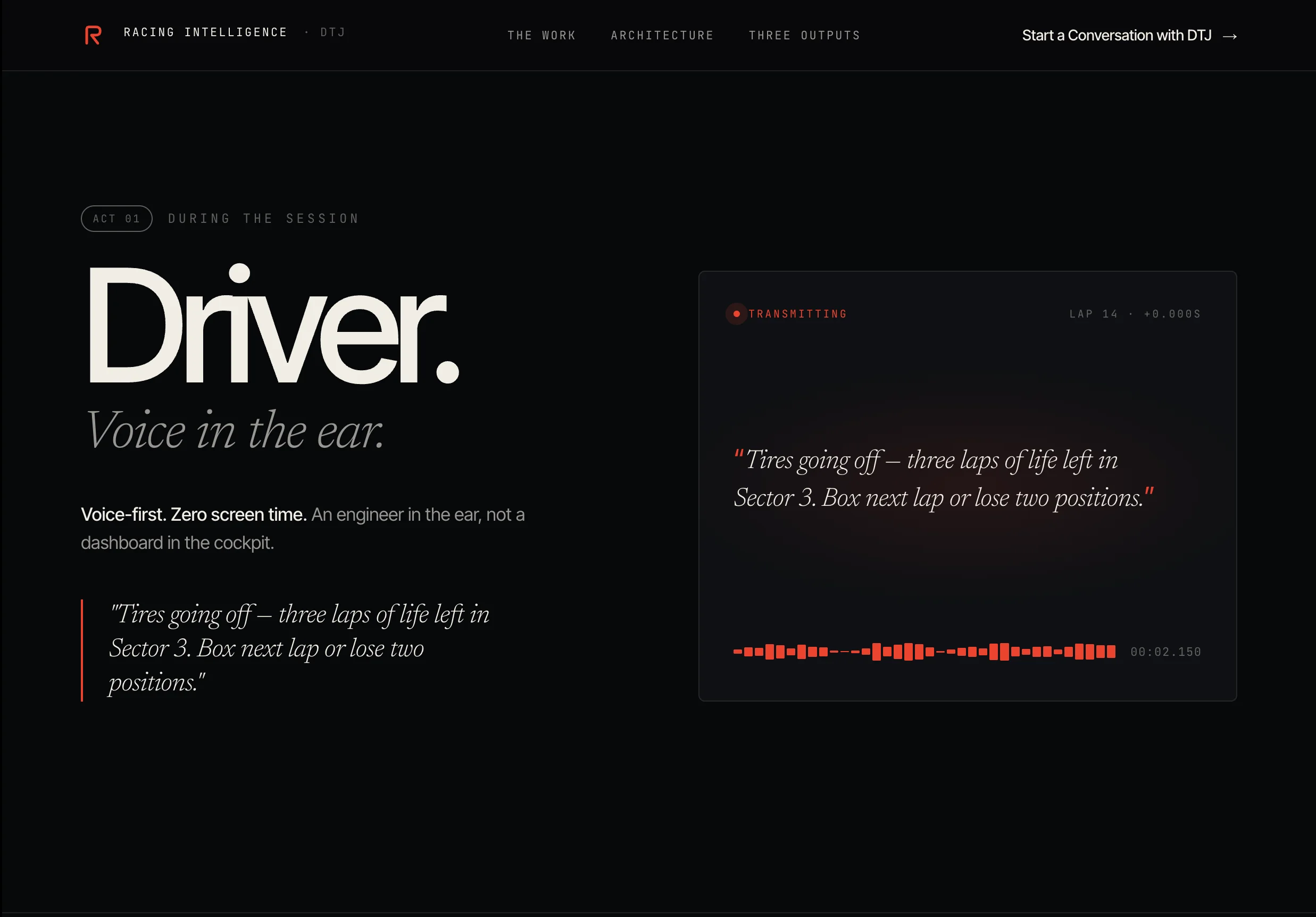
A voice layer fast enough for a real conversation between a human and a system while the engine is still warm.
Traditional telemetry tells you the numbers. We wanted the system to understand the story those numbers are telling.
That's the work.
It transfers.
The same architecture finds defects on a manufacturing line. Tracks pallets across three warehouses. Helps a clinician work across two scanners.
A car at 280 km/h is a faster version of every system we've been asked to make smarter.
We don't think of racing as a vertical. We think of it as a stress test we're proud to run in public.
If you're curious, the work lives at racing.designthinkingjapan.com.
We'll be adding to it as we go.